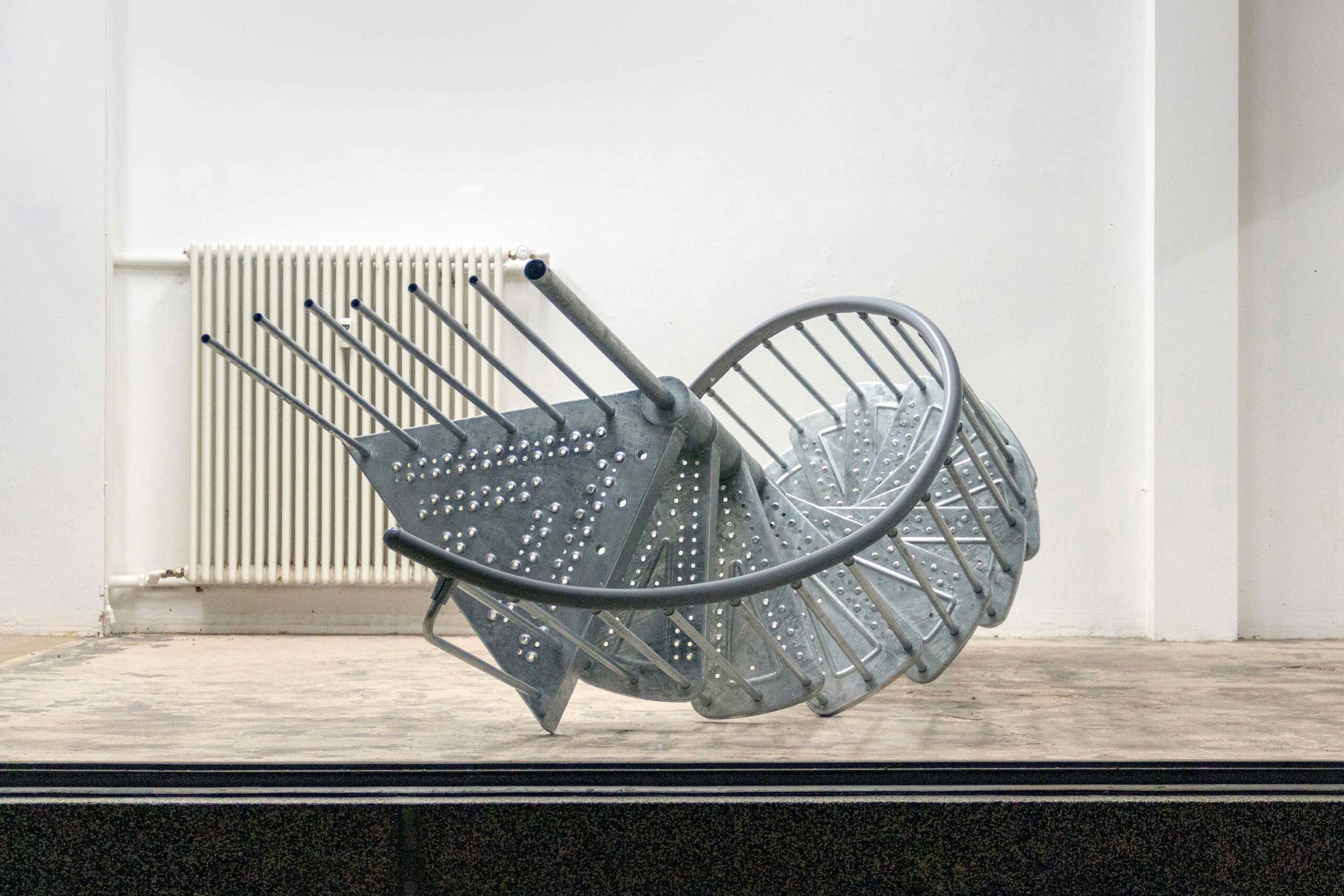
In Somewhere Now, Ceylan Öztrük gathers orientations that seem to have slipped from their usual alignments. The elevated space of Bacio is used as a kind of pedestal, offering a raised first view where the initial installation appears momentarily at eye level. What is visible from outside the box does not correspond to what unfolds once the viewer enters. The outside and inside experiences remain unique and separate, creating an awareness of the viewer’s presence and their relationship to the works.
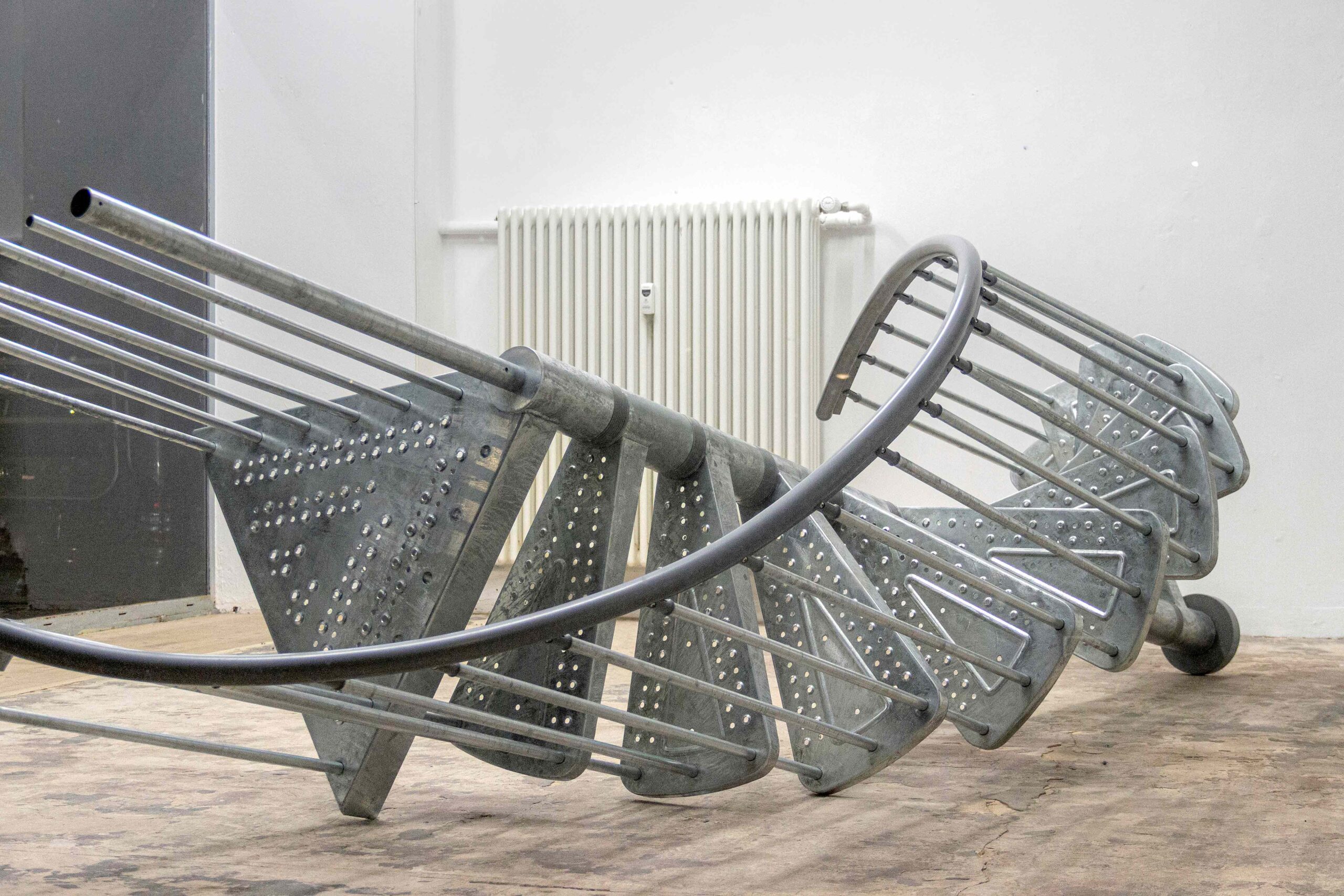
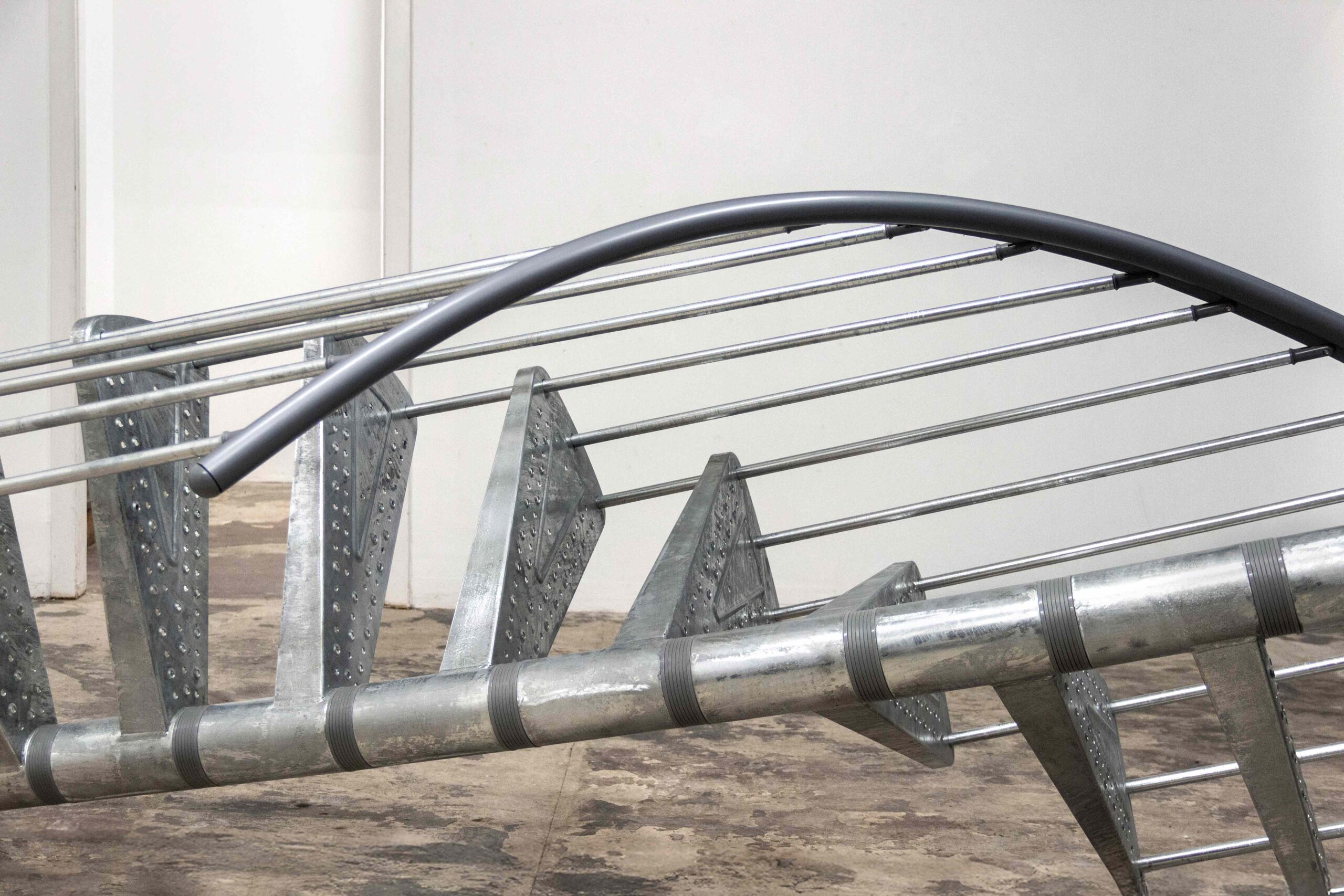
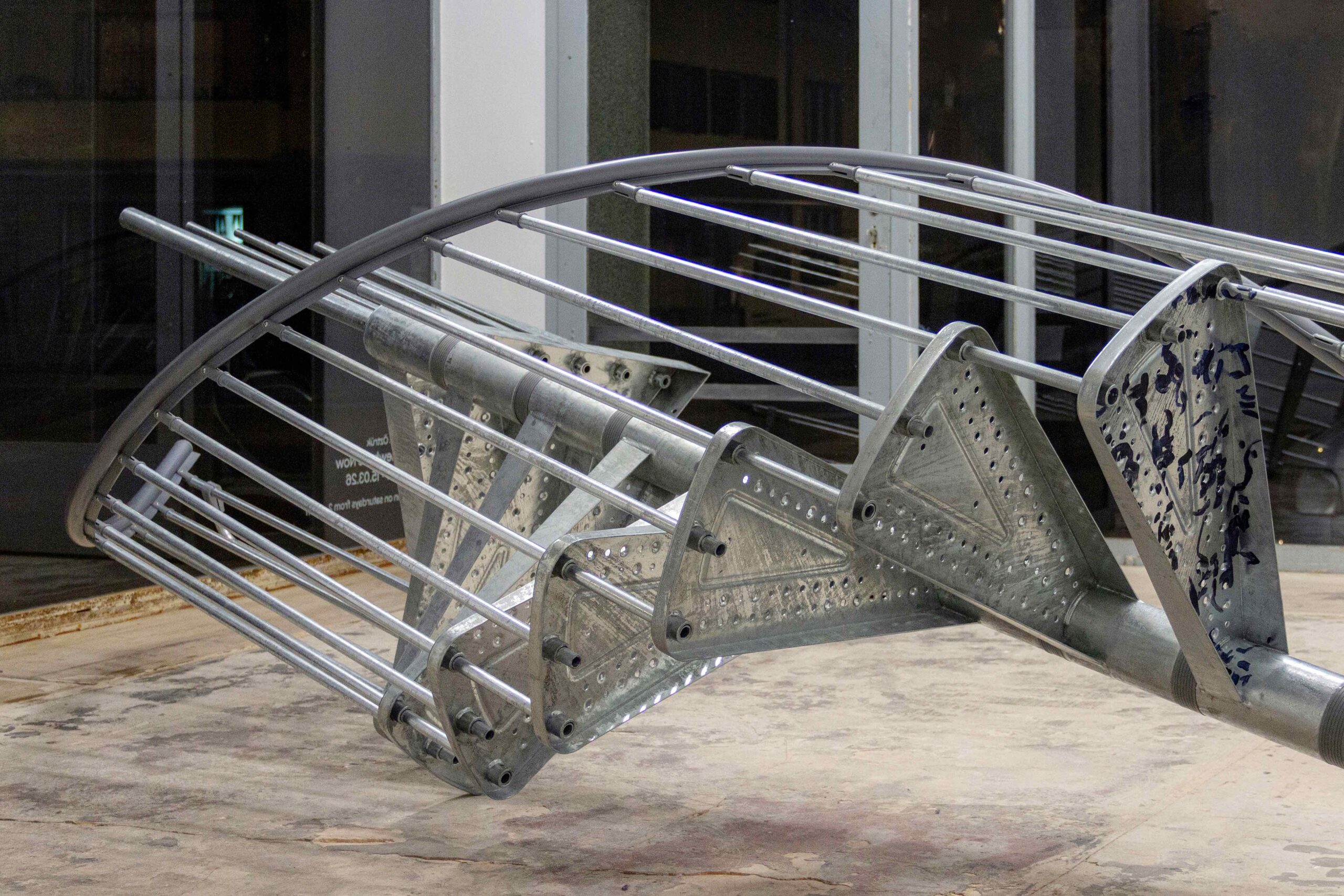
At the entrance, an aluminum spiral staircase lies on the floor. Removed from its function and placed in another orientation, it first reads as something else entirely — a flower, a seashell, a slowly unfolding geometry. From the angle at which it is first encountered, it recalls the proportions of the golden ratio. This room-sized structure no longer leads anywhere; instead, it settles into itself, becoming an object that generates its own time and space. When its function is no longer required, the staircase is seen rather than passed through. Functionality refers to a performance, as structures are usually not perceived, only moved through. In a dedicated space, the object withdraws its use; it becomes an object, not a structure. Its function has been removed; form comes forward, merging with the void. The object is revealed when distraction falls away — a moment Heidegger describes as a thunderbolt.
Elsewhere on the globe, this same placement would appear upright; in Bern, at Bacio, it appears horizontal. Nothing in the staircase changes. The moment does not change, but the coordinates of presence do.
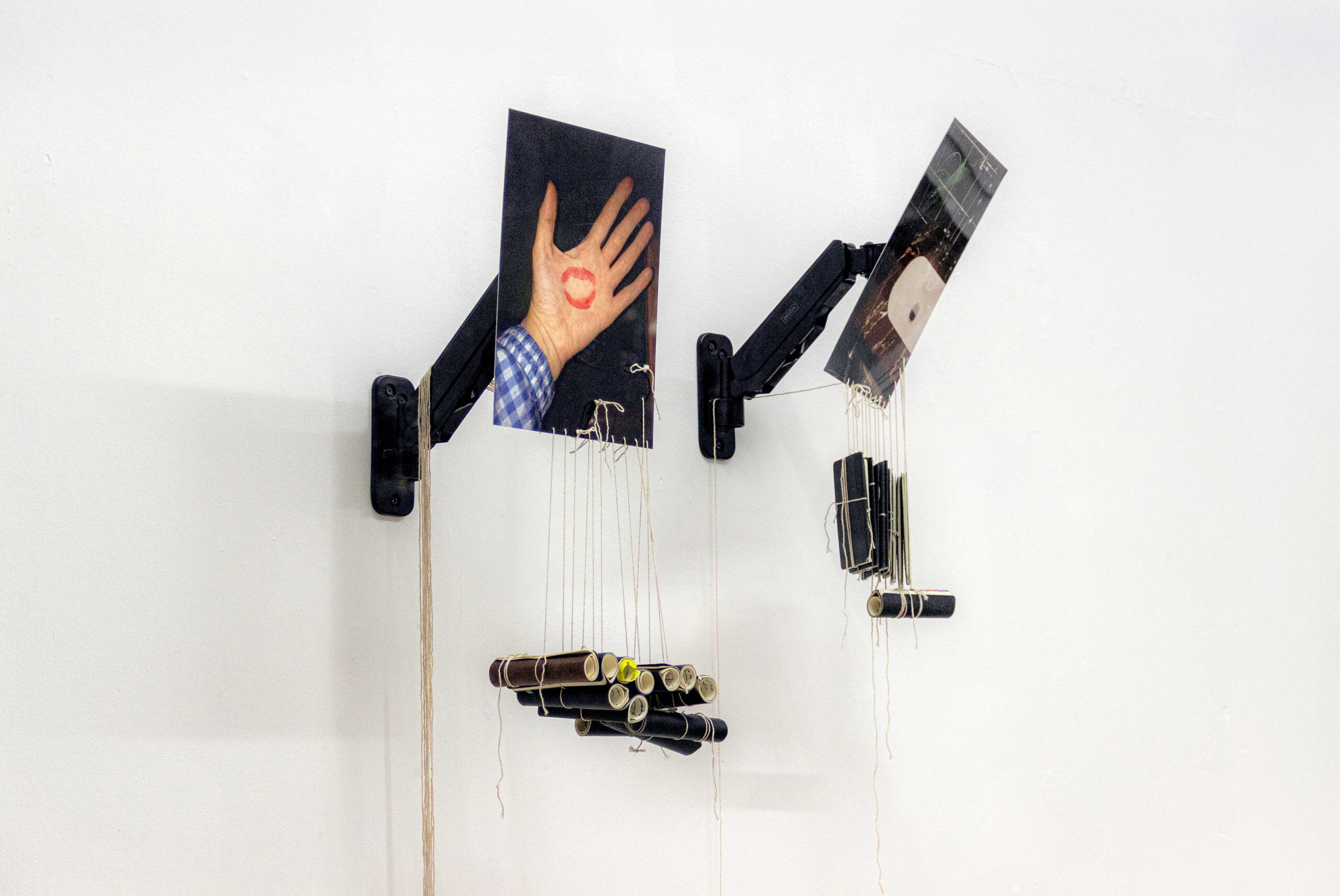
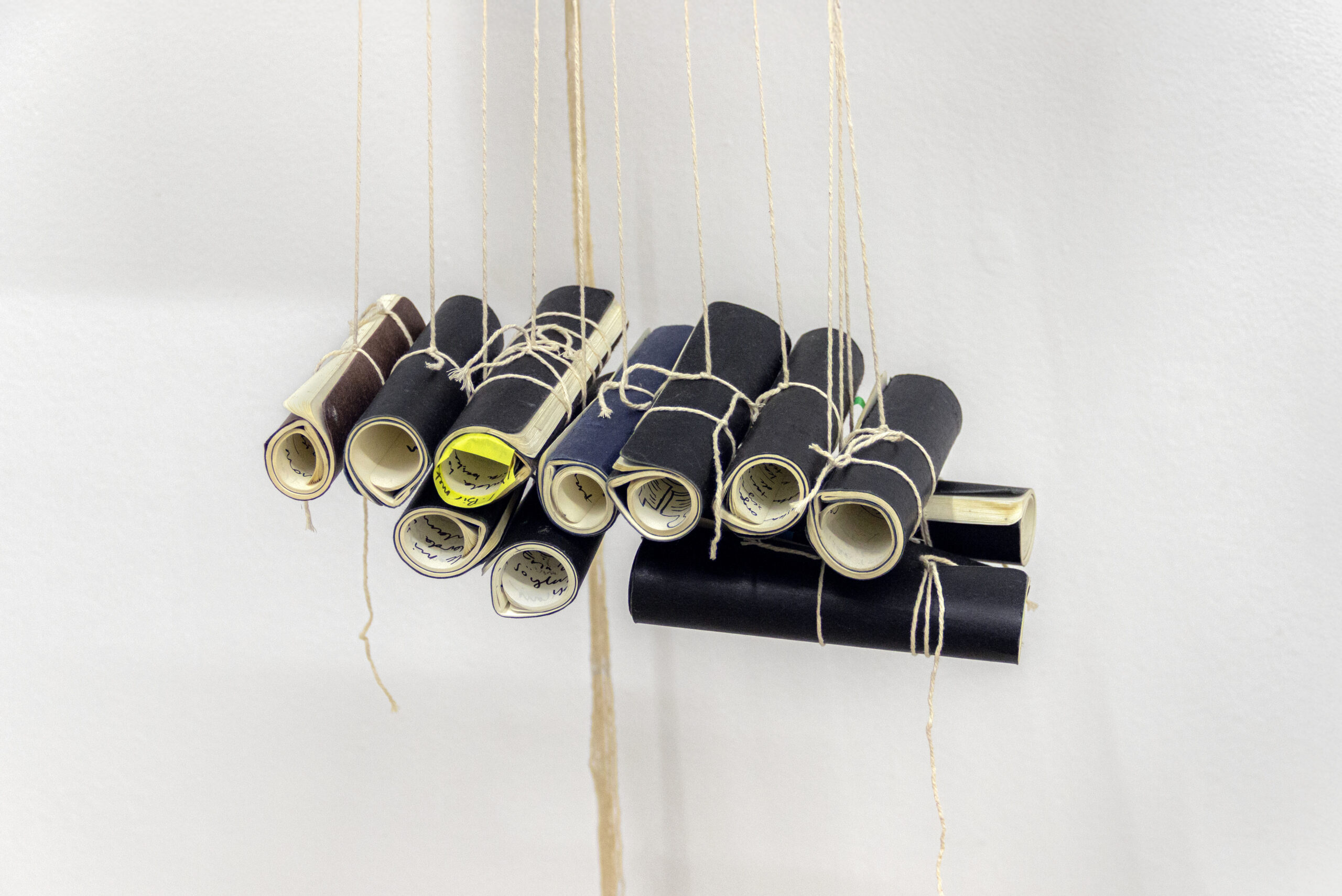
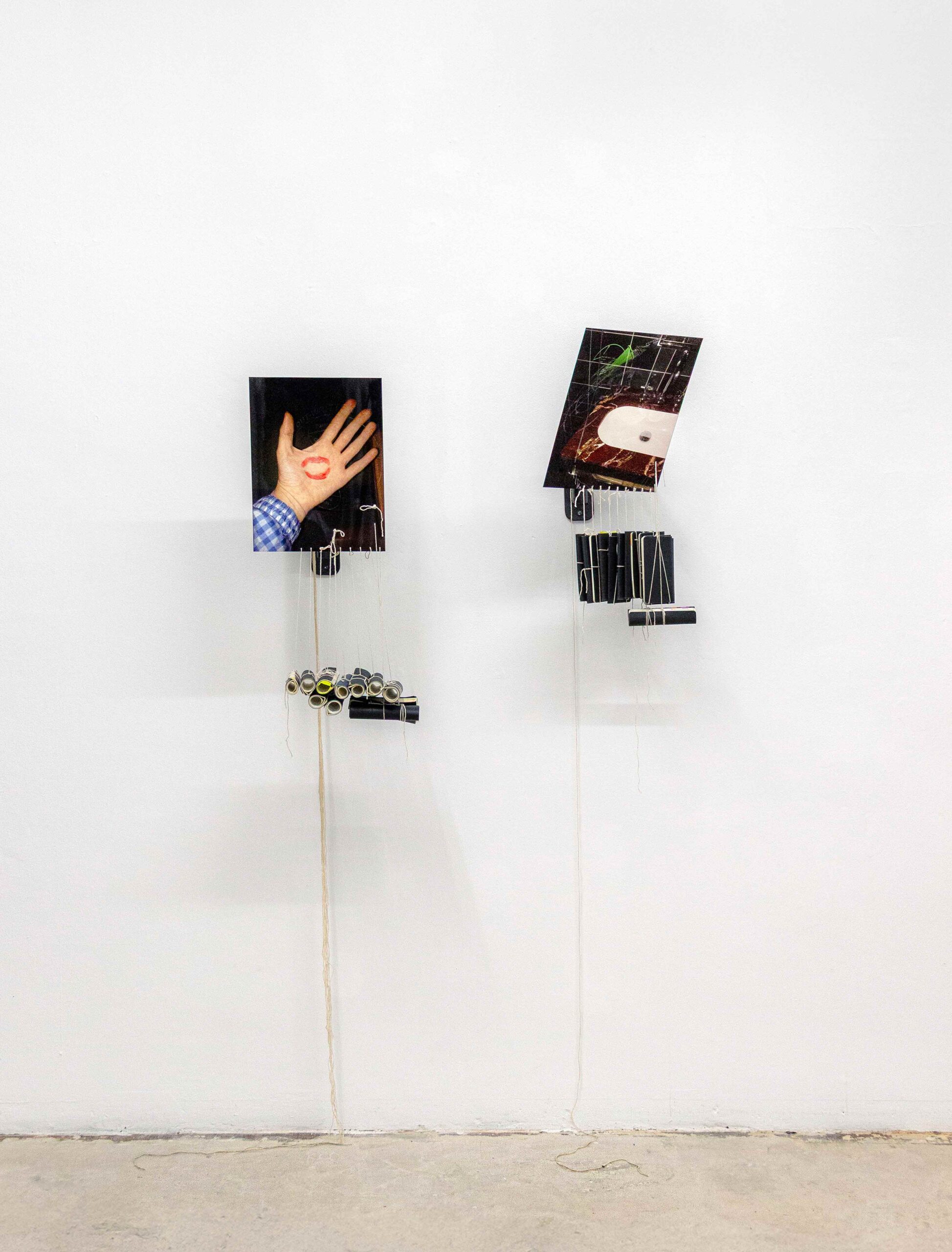
Further into the space, aluminum photographic prints spike out from the walls. Öztrük refers to them as vessels. Though they do not resemble vessels in any conventional sense, these flat surfaces hold their content through material presence alone. They carry fragments of other moments — notebooks, personal and worn, extending from the aluminum plates. Moments touch, overlap, and lean into one another.
Throughout the exhibition, horizontality and verticality are quietly unsettled. The vessels do not contain a void; instead, they appear alongside it, as companions rather than opposites. They are not representations but brief occurrences, taking place only in this precise configuration of time and space, destined to vanish once the moment passes.
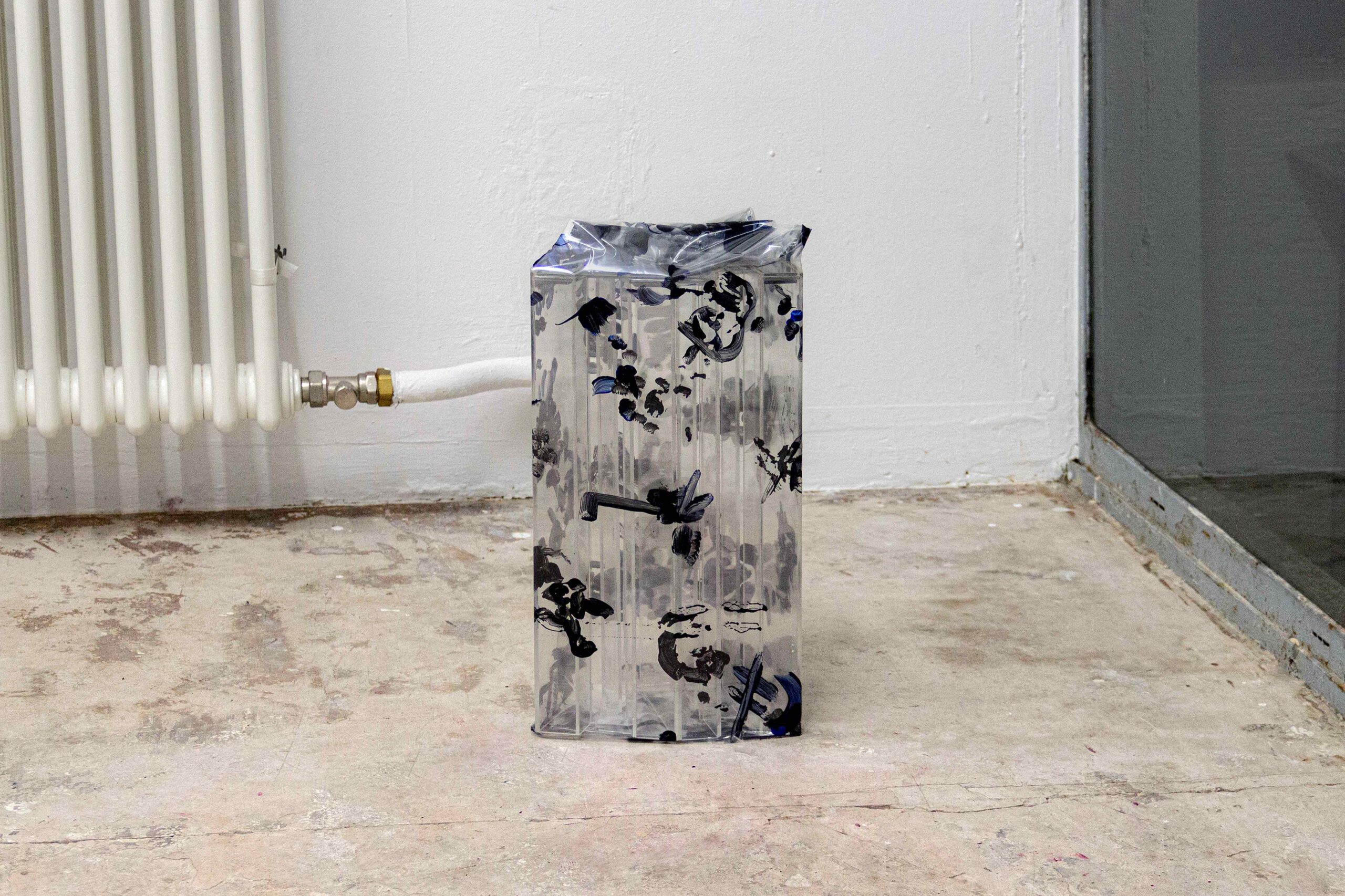
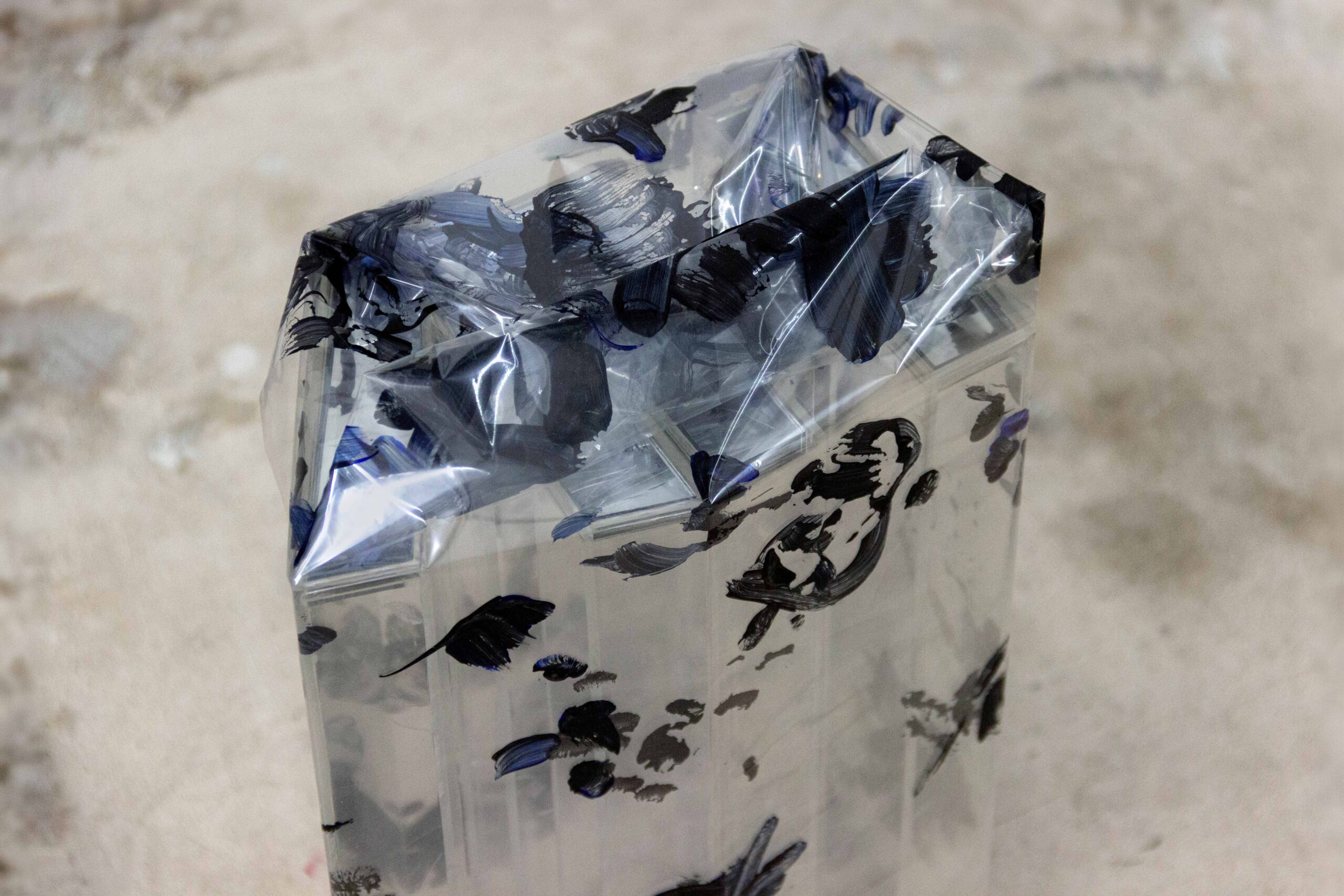
In the far corner, a plexiglass sculpture is wrapped in hand-painted folio by the artist. It appears as a filtered echo of a pattern that surfaces repeatedly — from the wrapping paper to the underside of the staircase. The folio does not conceal the object; it offers a suggestion of mediation, a hint of the lens through which things are seen, or perhaps the consciousness that accompanies seeing itself.
Somewhere Now unfolds as a sequence of encounters in which position, use, and reading remain unsettled. What appears is never fixed, only briefly held by the space and by the viewer moving through it. Seeing is shaped by position, and position is never neutral. These moments exist only here, only now, before slipping again into elsewhere.
Bacio, Bern, 2026